


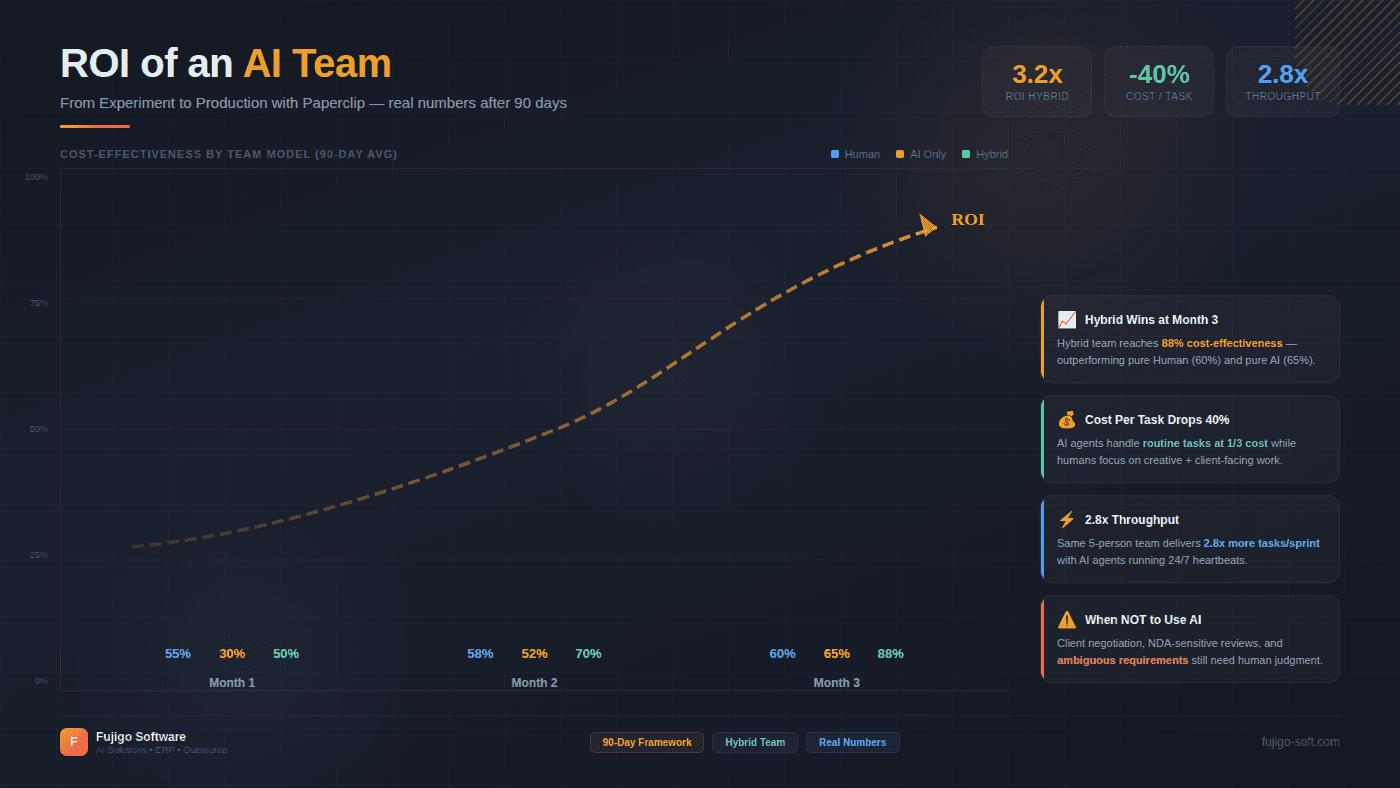
Everyone says AI agents cut costs. But by how much? Compared to what? Over what timeline? Here are real numbers from 3 months of running an AI team through Paperclip at a 5-person outsource shop.
You have read about how Paperclip works under the hood, org charts, task management, choosing an AI model, and GitHub integration. Now the question CTOs and CEOs actually care about: is it worth it?
What an AI Team Actually Costs
AI agents are not free. Ignore articles claiming “AI replaces developers at near-zero cost.” That is marketing, not reality.
Costs fall into three buckets:
- API tokens — The cost of calling an LLM. Claude Opus, GPT-4, Gemini Pro each price differently, and costs scale with how much code an agent processes per day. A backend agent handling 5-8 tasks per week runs roughly $40-80/month depending on the model.
- Infrastructure — The server running Paperclip, the database, CI/CD tooling. Running locally on an existing machine: nearly $0 incremental. Running on cloud: $20-50/month for a small instance.
- Management overhead — The human time spent reviewing AI output, fixing edge cases, and writing clearer specs. This is the cost most teams forget to account for.
Sample cost breakdown for a 5-agent team (CEO, CTO, 2 Backend Engineers, QA):
| Category | Estimated monthly cost |
|---|---|
| API tokens (5 agents) | $200–350 |
| Infrastructure (local) | $0–50 |
| Human review time (~15h/month) | Absorbed into existing salary |
| Total direct cost | $200–400/month |
Compare this to a single full-time developer: $3,000-6,000/month in most markets. A 5-agent AI team costs 5-10% of one developer’s fully loaded salary.
But that number tells half the story. A real developer handles ambiguity — phone calls from clients mid-sprint, design discussions, mentoring juniors. AI agents do not. The cost is lower because the scope is narrower.
AI vs Human vs Hybrid — The Right Ratio Matters More Than the Right Tool
“Should we use AI or humans?” is the wrong question. The right question: “Which ratio, for which types of tasks?”
| Criteria | Pure Human | Pure AI | Hybrid |
|---|---|---|---|
| Monthly cost (team of 5) | $15,000–30,000 | $200–400 | $10,000–20,000 |
| Delivery speed | 1x (baseline) | 3-5x for defined tasks | 2-3x average |
| Code quality | Varies by experience | Consistent but needs review | Highest (AI speed + human judgment) |
| Handling ambiguity | Strong | Weak | Strong (humans handle the fuzzy parts) |
| Risk profile | Attrition, burnout | Hallucination, context limits | Balanced |
Scenario: Your sprint has 20 tasks. 12 are CRUD endpoints, pagination, validation — well-defined, with clear specs. 5 are third-party integrations requiring vendor documentation and debugging. 3 are architecture decisions for a new module.
With a hybrid model: 12 CRUD tasks go to AI agents — done in 2-3 days. 5 integration tasks go to developers, with agents assisting on boilerplate and test generation. 3 design tasks stay entirely human.
Result: a 2-week sprint finishes in 8-10 working days. Developers spend their time on high-value work instead of repetitive CRUD.
A useful starting framework for task allocation:
| Task type | Primary owner | Examples |
|---|---|---|
| Repeatable, well-defined | AI-first | CRUD, pagination, validation, unit tests |
| Requires external context | Human-first | Vendor integration, client communication |
| Creative or ambiguous | Human-first | Architecture decisions, UX research |
| Repetitive but needs judgment | Hybrid | Code review, test strategy, refactoring |
When AI Agents Deliver the Highest ROI — 4 Conditions
Not every team sees returns from AI agents. Over 3 months, four conditions consistently predicted success or failure:
Condition 1: Tasks have clear specs. An agent takes a description and acceptance criteria as input and produces code as output. Vague descriptions (“make that form look nicer”) produce hallucinated requirements. Clear specs produce correct output.
Condition 2: The codebase has structure. Linting rules, naming conventions, test infrastructure, a CI pipeline — all already in place. Agents follow existing conventions. If the codebase is a wild west with no rules, agents add chaos rather than value.
Condition 3: Code review is real, not ceremonial. Quality gates — CTO reviews code, QA runs tests, CEO verifies business alignment. AI code is fast but not always right. Gates catch problems before production. No gates means technical debt accumulates at the same speed as code output.
Condition 4: The team lead understands AI. Knows when to delegate to an agent and when to handle it personally. Knows how to write task descriptions with sufficient clarity. Can read AI output and spot incorrect patterns. This is a new skill — no one teaches it in school.
Miss one condition: ROI drops 30-40%. Miss two: ROI may not materialize. Miss all four: AI agents create more problems than they solve.
When NOT to Use AI Agents
Knowing when not to use a tool is the mark of a mature team. Do not force AI into every gap.
R&D or exploration projects. Requirements change daily. Prototypes get thrown away. Agents need stable specs — if specs shift constantly, re-work costs exceed speed gains.
Legacy codebases without tests. A 10-year codebase, 0% test coverage, no documentation, inconsistent conventions. Agents will write code that “works” but adds technical debt. Fix the codebase first, then bring in AI.
Teams without review culture. If pull requests merge without anyone reading the diff, do not add AI. Fast AI code plus no review equals technical debt at unprecedented speed. Build review habits first.
Clients requiring 100% human development. Some outsource contracts explicitly require human developers. Compliance, NDA terms, or simply client preference. Respect the requirement.
“If you are running 1 agent and the results are poor — the problem may not be AI. The problem is process.”
A Decision Framework — 5 Questions, 10 Minutes
If you have read this far, you are probably asking: “Should my team try this?” Five questions to decide:
Question 1: Does your backlog have at least 60% well-defined tasks? Open the backlog and count. How many tasks have clear acceptance criteria — enough detail that a new developer could start without asking questions? If 60% or more: AI agents have room to operate.
Question 2: Are you willing to invest 2-4 weeks of setup? Installing Paperclip takes 15 minutes. But designing an org chart, writing proper specs, and building a review process takes 2-4 weeks. This is a one-time investment, but it is mandatory.
Question 3: Does your team practice real code review? Not rubber-stamp approvals. If the team already reviews PRs seriously, AI code goes through the same process. If the team has no review habit, build that first.
Question 4: Is $200-500/month acceptable? API token costs for a 5-agent team. If that budget equals one team dinner, it is worth a trial. If $200/month is a hard constraint, the timing may not be right.
Question 5: How do you measure output? Story points shipped? Features delivered? Lines of code? If you measure “hours at the desk,” AI agents will break that metric. Agents do not sit at desks — they deliver output. You need output-based metrics.
| Result | Recommendation |
|---|---|
| 4-5 “Yes” answers | Strong fit — start a pilot now |
| 2-3 “Yes” answers | Small pilot — 1-2 agents, 1 project |
| 0-1 “Yes” answers | Not yet — improve your process first |
The 90-Day Roadmap — Experiment to Production
No one should go all-in on day one. 90 days, 3 phases.
Month 1 — Pilot: Learn How an AI Team Operates
Goal: run 1-2 agents on a small project, measure baselines.
- Install Paperclip, create a company, spin up a CEO agent
- Choose a project with clean specs and a well-structured codebase
- Assign 10-15 well-defined tasks (CRUD, tests, bug fixes)
- Measure: completion time, API cost, first-pass review approval rate
- Month 1 KPI: agents complete 70%+ of tasks without major rework
Month 2 — Scale: Build a Real Team
Goal: 3-5 agents, org chart, quality gates.
- Add agents following the org chart model: CEO, CTO, Engineers, QA
- Enforce quality gates — G1 (CTO review) and G2 (QA testing) are mandatory
- Track budget: adapter config per agent shows who costs what
- Measure: cost per task, post-AI bug rate, sprint velocity delta
- Month 2 KPI: cost per task drops 20%+ versus month 1
Month 3 — Production: Hybrid Team in Real Sprints
Goal: AI team participates in sprints alongside human developers.
- GitHub integration: AI agents create PRs, pass review, merge to develop
- Hybrid workflow: agents handle defined tasks, humans handle ambiguous ones
- Performance review: compare velocity, quality, and cost before and after AI
- Measure: total team cost, delivery timelines, client satisfaction
- Month 3 KPI: total cost per feature drops 30%+ with no increase in bug rate
| Month | Agents | Focus | Key KPI |
|---|---|---|---|
| 1 | 1-2 | Pilot, baseline | 70%+ tasks pass review first try |
| 2 | 3-5 | Scale, quality gates | Cost per task down 20%+ |
| 3 | 5+ | Production, hybrid | Cost per feature down 30%+ |
“If after 90 days, cost per feature drops 30-40% and bug rate holds steady — you have your answer.”
Where AI Teams Are Heading
Cost per token drops roughly 50% every year. New models ship every quarter. Agent frameworks are maturing. The ROI of your AI team will improve over time without additional effort on your part.
But the shift that matters more than technology is mindset. AI teams do not replace developers — they change how teams operate. A tech lead in 2026 needs a new competency: AI team management — designing org charts for agents, writing specs that agents can execute, reviewing AI output efficiently, and knowing when to delegate versus when to do it yourself.
The outsource company that masters this skill first gains a clear competitive edge: faster delivery, lower costs, more consistent quality — with the same human team.
If you are running 3+ developers and 60%+ of your tasks are well-defined — pilot an AI team for 30 days. If you do not yet have a review process — build that first. The AI agents will wait.


