

Working across Japanese and English isn’t just about language. It’s about navigating two entirely different communication cultures in real-time, while trying to keep projects on track.
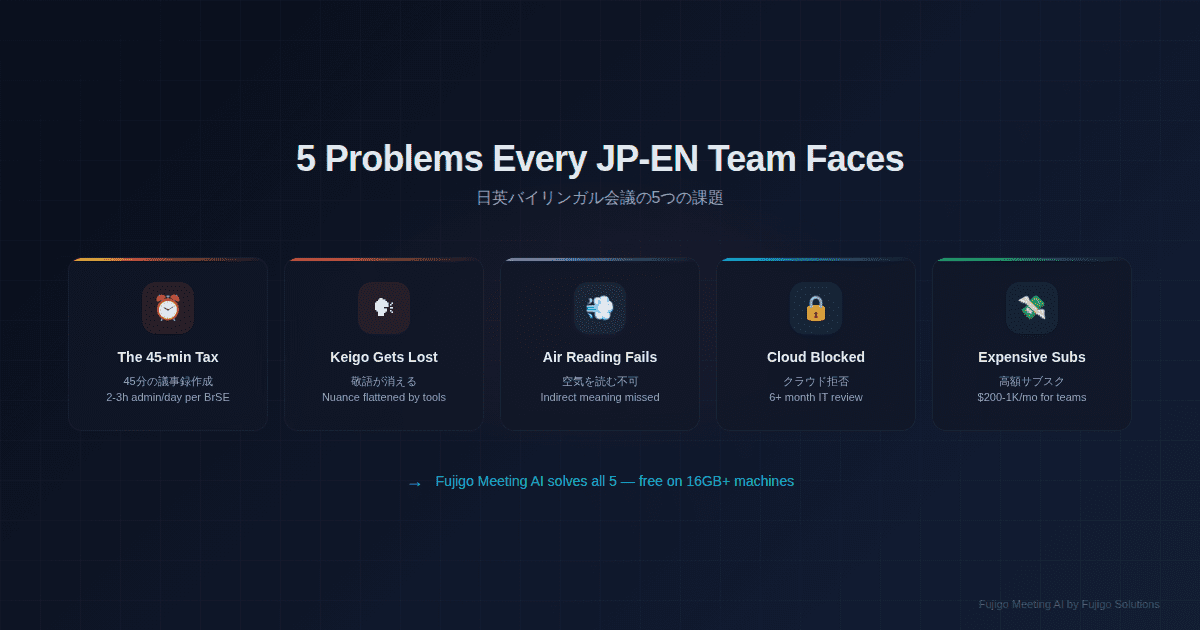
After talking to dozens of Bridge SEs and PMs at offshore development companies, we identified five recurring problems that cost teams hours every week.
1. The 45-Minute Meeting Tax
The problem: A one-hour meeting generates 45 minutes of post-meeting work — reconstructing notes, translating key points, and distributing action items in both languages.
For a BrSE attending 3-4 meetings per day, that’s 2-3 hours of pure administrative work. Every single day. Multiply that by 5 BrSEs on a team, and you’re looking at 50+ hours per week of meeting note-taking.
Why it happens: No tool simultaneously transcribes both languages with sufficient accuracy.
The fix: Use an AI transcription tool that handles both JP and EN simultaneously, then generates structured summaries automatically with action items tagged by language.
2. Keigo Gets Lost in Transcription
The problem: Japanese business communication relies heavily on keigo (敬語). When your client says 「ご検討いただけますでしょうか」, the meaning and urgency are encoded in the honorific form. Generic tools flatten these into casual Japanese.
Why it matters: Misunderstanding keigo levels leads to misread priorities. A polite suggestion might actually be a firm request. Missing this distinction damages trust.
The fix: Choose a transcription tool trained on Japanese business speech — keigo patterns, technical terms, and mixed JP-EN switching common in IT meetings.
3. “Air Reading” Doesn’t Translate
The problem: Japanese communication values 空気を読む (reading the air). Non-Japanese team members miss these signals entirely.
Common indirect patterns:
| What they say | What they might mean |
|---|---|
| 「少し難しいかもしれませんね」 | “This is a serious concern” |
| 「前向きに検討いたします」 | “Probably no” |
| 「ちょっと確認させてください」 | “I disagree” |
| 「他の方法もあるかもしれません」 | “Your approach is wrong” |
The fix: AI context analysis that understands Japanese business culture can flag indirect expressions and provide cultural context alongside translation.
4. Cloud Privacy Kills Deals in Japan
The problem: Japanese enterprises are strict about data sovereignty. Cloud-based meeting AI tools face a predictable path: security questionnaire → vendor assessment → DPA review → often rejection. The cycle can exceed 6 months.
The fix: Choose a tool with local processing — audio never leaves the machine. IT approval becomes a formality.
5. Expensive Subscriptions
The problem: Cloud transcription: $10-50/seat/month. Team of 20 = $200-1,000/month = $2,400-12,000/year.
The fix: Local STT on 16GB+ RAM hardware = unlimited free transcription. No API costs.
The Solution
| Problem | Fujigo Meeting AI Solution |
|---|---|
| 45-minute meeting tax | One-click AI summary with structured action items in both languages |
| Lost keigo | STT optimized for Japanese business speech including keigo patterns |
| Cultural context | AI dual-language suggestions with Japanese business context awareness |
| Cloud privacy | 100% local audio processing — audio never leaves your PC |
| Subscription costs | $0 local STT on machines with 16GB+ RAM |
Try Fujigo Meeting AI free → [fujigo-meeting.app]


