

 Vietnamese
 Japanese
 English
WorldClaw: Large-Scale 3D Open-World Generation with AI
Fujigo Software Solutions
Member of M&C Holdings (Japan)
title: ‘WorldClaw: Large-Scale 3D Open-World Generation with AI’ author: Fujigo pubDatetime: 2026-08-07T09:00:00+07:00 modDatetime: ‘’ description: WorldClaw is the latest AI method from Hugging Face, capable of generating large-scale 3D open worlds. Learn why this paper is trending with 23 upvotes and its potential applications in gaming, VR, and simulation. draft: false products: []
What is WorldClaw?
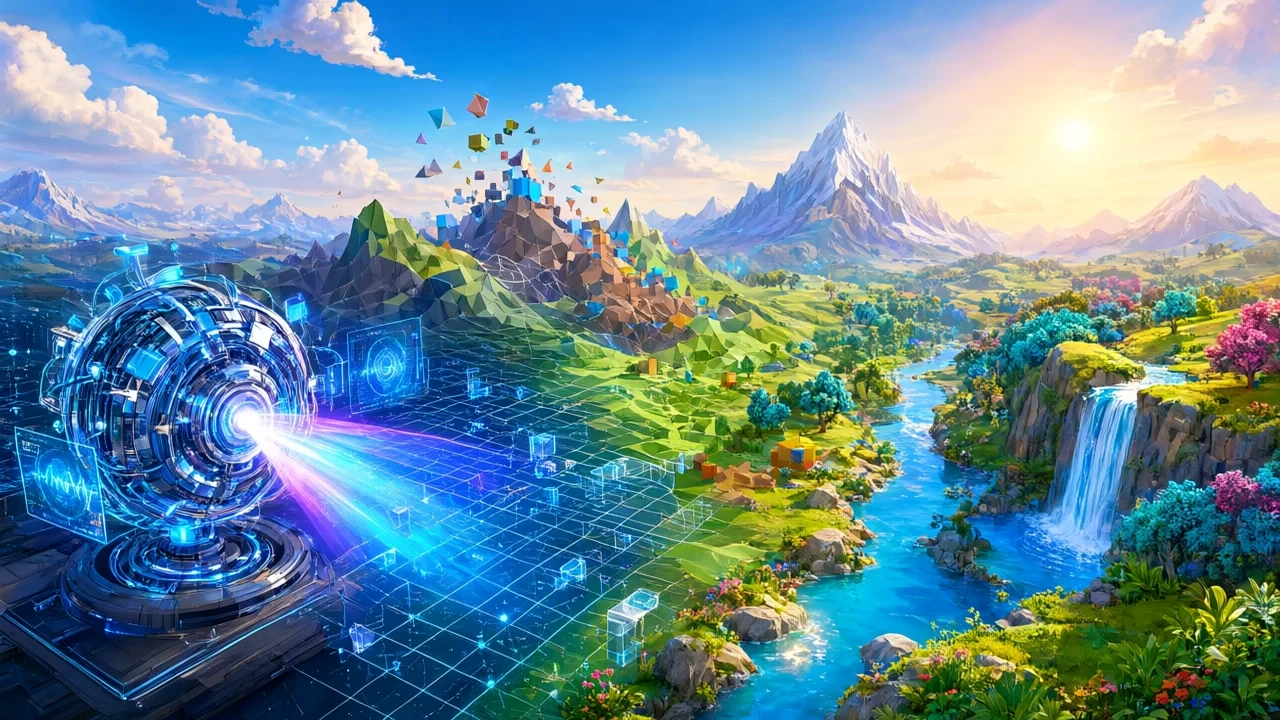
WorldClaw (Agentic 3D Open-World Generation at Scale) is a research paper currently ranked #2 on Hugging Face’s trending charts with 23 upvotes. It’s a breakthrough approach to generating large-scale 3D open worlds, opening new possibilities for gaming, virtual reality (VR), and simulation.
The Challenge of 3D World Creation
Creating complex 3D worlds has always been a significant challenge in the gaming and simulation industries:
- Time cost: Manually designing a 3D world can take months or even years
- Consistency: Ensuring elements within the world fit together in style and logic
- Scalability: Creating worlds large enough for users to explore without repetition
- Interactivity: Worlds need to be not just beautiful but also interactive
WorldClaw addresses these challenges by using AI agents to automatically generate large-scale 3D open worlds at unprecedented scale.
WorldClaw’s Architecture
WorldClaw uses a multi-layered architecture to generate 3D worlds:
Layer 1 - Layout generation: AI agent creates the overall layout of the world, determining positions of major areas like cities, forests, rivers, and mountains.
Layer 2 - Asset placement: Based on the layout, the system automatically places 3D assets (trees, buildings, vehicles) in appropriate positions, ensuring logic and aesthetics.
Layer 3 - Detail refinement: Fine-tunes small details like textures, lighting, and weather effects to create a vibrant world.
Layer 4 - Interaction mapping: Defines interaction points, paths, and game logic so the world is immediately playable.
What’s special is that this process is fully automated and can generate a new world in just minutes.
Why WorldClaw Matters
This method has significant implications for many industries:
Game development: Dramatically reduces time and cost of creating game content. Instead of needing a large team for manual design, a developer can create a complete game world in a short time.
Virtual reality: VR needs rich environments for users to explore. WorldClaw enables creating countless unique VR worlds, enhancing user experience.
Training simulations: Training simulations (driving, military, medical) need diverse environments. WorldClaw provides the ability to quickly create different training scenarios.
Film and animation: The film industry can use WorldClaw to create complex film backgrounds without building expensive physical sets.
Comparison with Existing Methods
Compared to traditional procedural generation (like in Minecraft):
- Procedural generation: Generates random worlds but lacks logic and aesthetics
- WorldClaw: Creates structured, logical, and aesthetically pleasing worlds thanks to AI agents that understand context
Compared to manual design:
- Manual design: High quality but time-consuming and expensive
- WorldClaw: Comparable quality but hundreds of times faster
Compared to other AI generation methods:
- NeRF/3D Gaussian: Only reconstructs worlds from existing images, cannot create new worlds
- WorldClaw: Generates completely new worlds with full interaction capabilities
Practical Applications
WorldClaw can be applied in many fields:
Open-world games: Generate open-world games like GTA or Skyrim at significantly lower costs.
Educational simulations: Create interactive learning environments for medical students, engineers, and pilots.
Urban planning: Simulate different urban planning scenarios to evaluate impacts.
Real estate visualization: Create 3D models of real estate projects before construction.
Impact on the Industry
WorldClaw represents a major step forward in automating content creation. Instead of requiring large teams of artists, level designers, and environment artists, small groups can create high-quality content.
This doesn’t mean replacing humans, but enhancing creativity. Developers can focus on gameplay mechanics and storytelling while AI handles world creation.
Conclusion
WorldClaw is not just a 3D world generation tool but a new direction for the creative industry. By combining AI agents with a multi-layered content creation process, this method opens up the possibility of creating rich virtual worlds at significantly lower cost and time.
With 23 upvotes and the #2 position on the trending charts, the research community and game developers are highly optimistic about WorldClaw’s potential. This could be the foundational technology for the next generation of games and VR/AR applications.
Original link: WorldClaw on Hugging Face