

 Vietnamese
 Japanese
 English
WorldClaw: Large-Scale 3D Open-World Generation with AI Agents
Fujigo Software Solutions
Member of M&C Holdings (Japan)
What is WorldClaw?
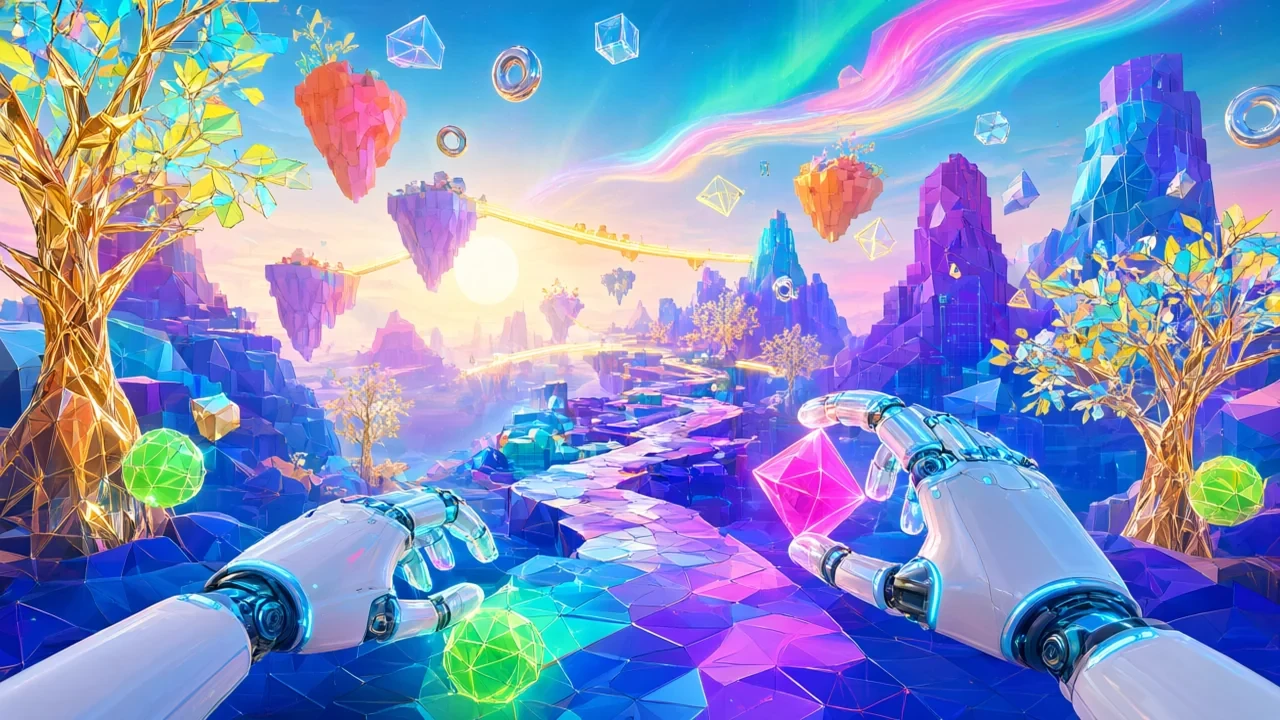
WorldClaw is a newly published research project gaining significant attention on HuggingFace Papers with 59 upvotes. It’s the first framework combining AI agents with large-scale 3D open-world generation processes.
Unlike traditional 3D content creation methods, WorldClaw uses multiple coordinated agents to automate the entire process - from architectural design and terrain creation to object placement in virtual worlds.
Why is WorldClaw Groundbreaking?
Creating open-world 3D environments is one of the biggest challenges in game development and simulation. WorldClaw addresses this problem in a completely new way:
Automating Complex Processes: Instead of artists manually creating each element, AI agents are assigned specific tasks - one agent designs cities, another creates forests, another places NPCs and interactive objects.
Ensuring Consistency: Agents communicate with each other to ensure the generated world has internal logic - roads connect properly, buildings have reasonable structures, natural ecosystems form.
Scalability: The framework can create worlds spanning hundreds of square kilometers in a short time, something impossible to do manually.
Technical Architecture
WorldClaw uses a multi-agent architecture with key components:
Planning Agent: Analyzes requirements and breaks them into specific tasks - “create a coastal city with 10,000 population”, “add an industrial zone to the north”.
Generation Agents: Each agent specializes in a content type - terrain generation, building placement, vegetation distribution, road networks.
Validation Agent: Checks the plausibility of the world after creation - ensures no physics conflicts, traffic works correctly, resources are balanced.
Coordination Layer: Manages communication between agents, resolves conflicts when two agents want to place objects in the same position.
Practical Applications
WorldClaw opens up many interesting applications:
Game Development: Indie studios can create AAA game worlds without teams of hundreds. Development time reduces from years to weeks.
Urban Simulation: Urban planners can create detailed 3D city models to test different development scenarios.
AI Training: Create diverse environments for robots and autonomous vehicles to learn - thousands of different scenarios without collecting real-world data.
Virtual Tourism: Create 3D replicas of historical or imaginary locations for VR/AR experiences.
Challenges and Future Directions
Despite being impressive, WorldClaw still has limitations:
Artistic Quality: Generated worlds may lack “soul” - the subtlety that human artists bring. Need to combine AI generation with human curation.
Performance Optimization: Large worlds need optimization for real-time rendering - level of detail, occlusion culling, streaming.
Cultural Diversity: Agents need training on diverse data to create worlds reflecting many cultures, not just Western styles.
Conclusion
WorldClaw represents an important step forward in applying AI agents to 3D content creation. Rather than replacing artists, the framework enhances their capabilities - allowing them to create more complex, diverse worlds in less time.
For businesses in gaming, simulation, or VR/AR, WorldClaw is technology worth watching and experimenting with. This is no longer theoretical research but approaching practical application.
Source: HuggingFace Papers - WorldClaw: Agentic 3D Open-World Generation at Scale