

 Vietnamese
 Japanese
 English
DreamX-Phi 1.0: Action-conditioned video world model for robotic manipulation
Fujigo Software Solutions
Member of M&C Holdings (Japan)
What is DreamX-Phi 1.0?
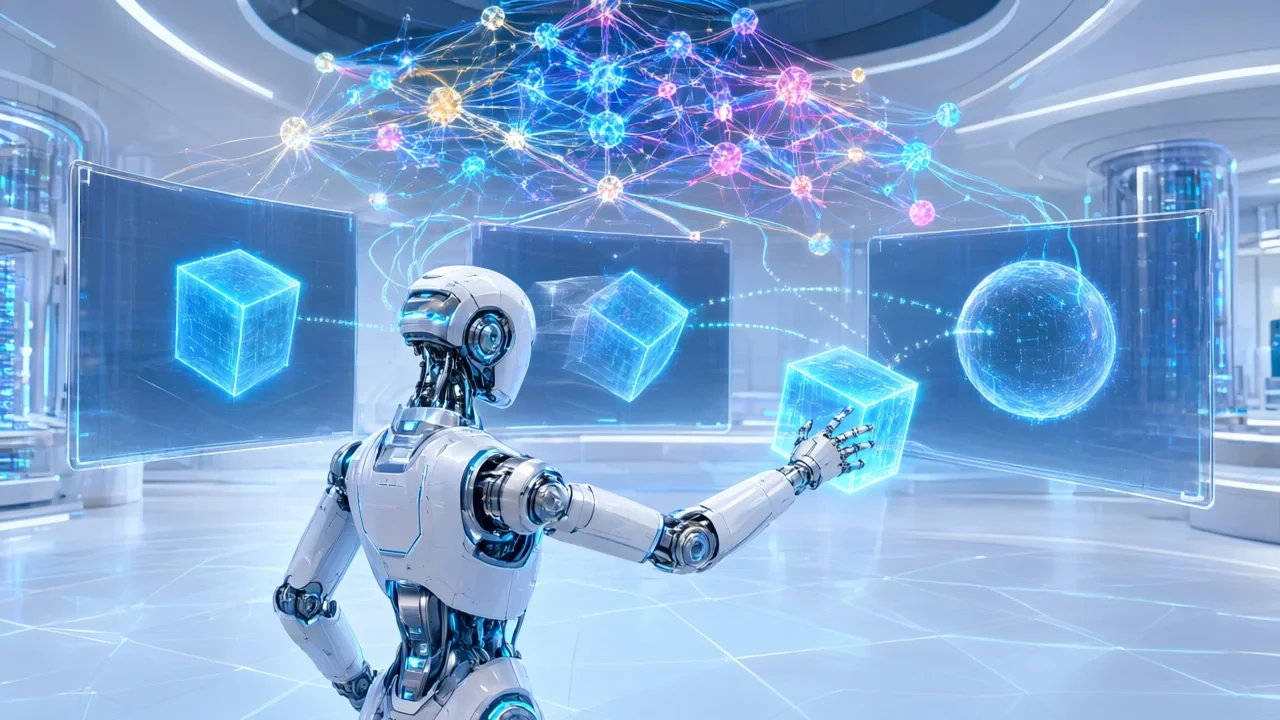
DreamX-Phi 1.0 is an action-conditioned video world model — a model that predicts what future video frames will look like given a robot’s specific actions. Instead of passively observing the environment, this model learns to “dream” about what will happen next when a robot performs a particular action, enabling more precise object manipulation.
This paper is currently ranked #3 on Hugging Face’s Daily Papers leaderboard with 91 upvotes, demonstrating significant interest from the AI research community in applying world models to robotics.
Why video world models matter for robots
One of the biggest challenges in robotics is sample efficiency — robots need to learn from as few real-world interactions as possible. Traditional methods require thousands to millions of real-world trials, which is expensive and potentially unsafe.
Video world models address this by:
- Learning a “dream” of the world: The model learns to predict the next video frame based on the current state and the action taken.
- Planning in imagination: Robots can “try out” many different actions in an imagined space before executing them in reality.
- Minimizing physical interactions: Instead of trial-and-error in the real world, robots optimize their policies in a simulated environment generated by the world model.
What makes DreamX-Phi 1.0 stand out
DreamX-Phi 1.0 builds on the DreamX architecture but focuses specifically on manipulation tasks — object manipulation using robot hands. It uses a transformer-based architecture (similar to Phi) to encode both observation images and action vectors, then predicts future video sequences.
Key features include:
- Action-conditioned generation: Generated videos depend on specific actions, not just passive prediction.
- Temporal consistency: Predicted frames maintain temporal coherence without jumps or discontinuities.
- Zero-shot transfer: The model can generalize to new tasks without fine-tuning.
Real-world applications
DreamX-Phi 1.0 opens up several exciting applications:
- Factory pick-and-place robots: Robots learn to grasp and place objects by “dreaming” about the outcome before acting.
- Surgical robotics: The model predicts tissue response as surgical instruments move, enabling more precise planning.
- Home robots: Learning to arrange furniture, open doors, or cook by imagining the results first.
Implications for the AI industry
The success of DreamX-Phi 1.0 reinforces the world models trend in AI — instead of learning policies directly from data, models learn an internal “world model” and use it for planning. This is the approach that researchers like Yann LeCun have advocated for years.
With 91 upvotes on Hugging Face and growing community attention, DreamX-Phi 1.0 shows that video world models are becoming one of the hottest research directions in AI robotics in 2026.
References
- Paper: DreamX-Phi 1.0: Action-Conditioned Video World Model for Robotic Manipulation
- Hugging Face Daily Papers: https://huggingface.co/papers