

 Vietnamese
 Japanese
 English
What Is an AI Agent? Why It's a Bigger Turning Point Than ChatGPT
Fujigo Software Solutions
Member of M&C Holdings (Japan)
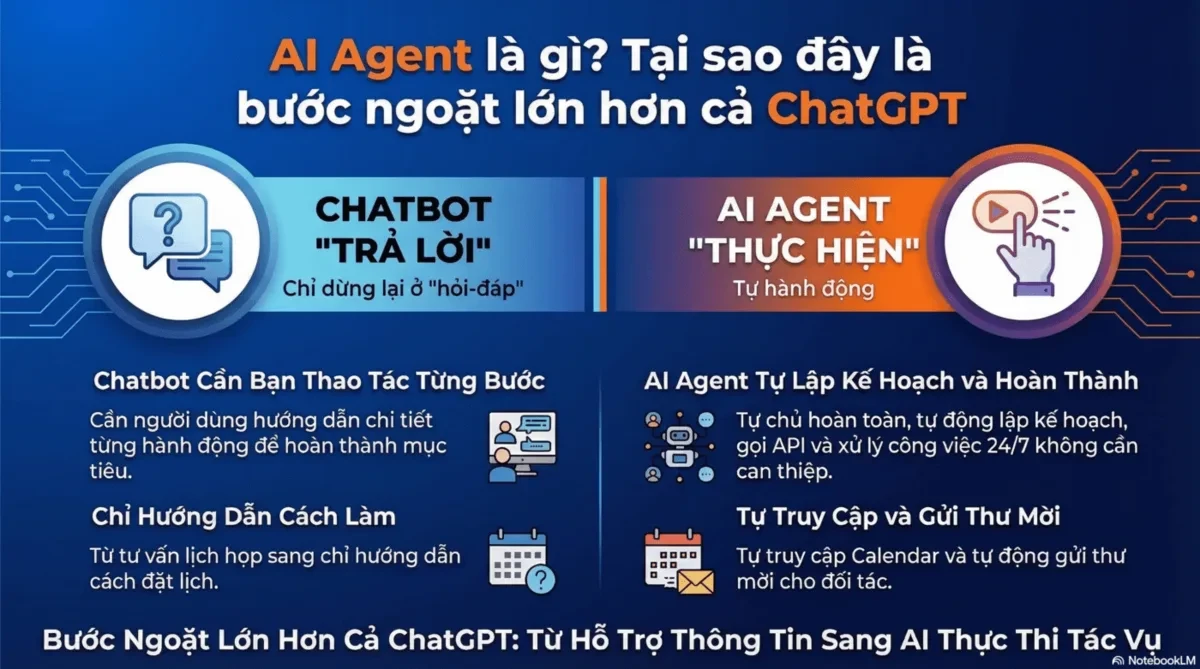
In early 2026, an open-source project named OpenClaw surpassed 163,000 stars on GitHub just a few months after its release. Major technology corporations in China, such as Tencent and Alibaba, raced to integrate or develop similar products. International media, from Bloomberg to CNBC, reported on it all at once. Everything revolved around a single concept: AI Agent.
So what is an AI Agent, and why is it considered the next step forward after ChatGPT?
From question-and-answer AI to action-taking AI
Large language models (LLMs) such as ChatGPT, Gemini, and Claude have changed the way we work: searching for information, writing content, analyzing data, and supporting programming. However, they all operate according to a common model: you ask, the AI answers.
AI Agentgoes one step further. Instead of merely answering, an AI Agent can perform actions on its own to complete a task: sending emails, looking up orders in a system, scheduling meetings, running commands on a server, or even controlling smart devices.
In other words: if the LLM is the brain, then the AI Agent is the entire nervous system—with hands, feet, and the ability to interact with the real world.
Comparison: AI Chatbot vs. AI Agent
| Criteria | AI Chatbot (LLM) | AI Agent |
|---|---|---|
| How it works | Question – Answer | Receive a task → Plan → Execute |
| System interaction | None – only generates text | Yes – calls APIs, runs commands, accesses data |
| Example | “The way to check an order is…” | Accesses the system on its own and returns the result for order #12345 |
| Level of autonomy | Depends on the user at every step | Operates on its own; you only need to describe the goal |
| Continuous operation | None – requires the user to open the chat | Yes – runs 24/7 and responds across multiple channels |
How does an AI Agent work?
An AI Agent handles a task through 5 steps:
- Receive the request – From the user via chat, message, or a webhook from a system.
- Analyze & plan – The LLM understands the content and determines what needs to be done and which tools to use.
- Call the tools (Tools) – Access APIs and databases, run scripts, read/write files.
- Execute actions – Send emails, update data, generate reports, schedule appointments…
- Return the result – Respond to the user through the original communication channel.
The key difference: this entire process happens automatically, without the user having to give step-by-step instructions.
A real-world example: Scheduling a meeting with an AI Agent
To see the difference clearly, let’s look at a concrete example:
With an ordinary AI Chatbot:
You: “Schedule a meeting with the marketing team at 2 p.m. on Thursday”
AI: “You can open Google Calendar, select Thursday, create an event at 14:00, and invite the members of the marketing team.”
→ You still have to do everything yourself.
With an AI Agent:
You: “Schedule a meeting with the marketing team at 2 p.m. on Thursday”
AI Agent: Checks the members’ availability → Creates the event on the Calendar → Sends the invitation emails → Replies: “I’ve scheduled the meeting for 14:00 on Thursday with 5 members. Everyone has accepted the invitation.”
→ Done. No further action needed.
Why did AI Agents explode in 2026?
AI Agent is not a new concept, but 3 factors have driven its dramatic explosion this year:
- **LLMs are smart enough:**Models like Claude, GPT-4o, and Gemini have reached a level of reasoning strong enough to plan and use tools reliably.
- **Mature frameworks:**Open-source projects like OpenClaw have solved the challenge of connecting LLMs to real-world systems, enabling anyone to build an AI Agent.
- **Demand for automation:**Businesses need AI that doesn’t just answer but actually does the work—processing orders, caring for customers, managing systems.
Will AI Agents replace humans?
The short answer: No. An AI Agent is a supporting tool, not a replacement.
What AI Agents do well: repetitive tasks with clear processes that require speed and consistency. For example: looking up data, sending notifications, generating periodic reports, and answering FAQs.
What still requires humans: making strategic decisions, handling complex situations without precedent, creativity, and building customer relationships.
The ideal model is “AI-assisted”—the AI Agent handles the routine part while humans focus on the high-value part.
Conclusion
AI Agent marks the shift from “AI that can talk” to “AI that can act.” With the maturity of LLMs and frameworks like OpenClaw, building an AI Agent is no longer the privilege of Big Tech but has become feasible for every business.
In the following articles, we will dive deeper into OpenClaw—the framework the international community currently rates as the most powerful AI Agent platform available—and how to apply it to the real-world operations of Vietnamese businesses.