

 Vietnamese
 Japanese
 English
What Is OpenClaw? Understanding the AI Agent Platform Shaking Up the Tech World
Fujigo Software Solutions
Member of M&C Holdings (Japan)
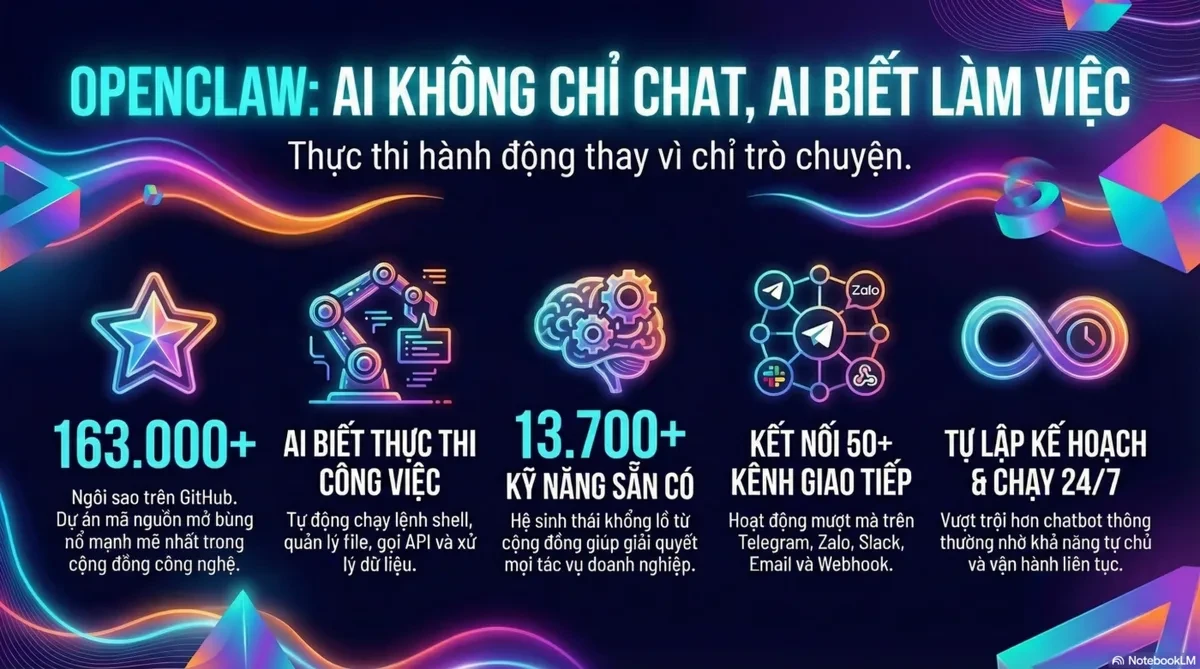
If you followed technology news in early 2026, you almost certainly could not miss the name OpenClaw. This open-source project surpassed 163,000 GitHub stars, attracted more than 5,700 community-contributed skills, and became the focal point of the global AI Agent race. Bloomberg, CNBC, and MIT Technology Review all devoted analytical articles to it. Tencent launched a similar product called WorkBuddy.
So what exactly is OpenClaw, and why does it matter so much?
OpenClaw – Not a chatbot, but an AI that gets work done
OpenClaw is an open-source AI Agent framework developed by Peter Steinberger, an Austrian developer. The project launched in November 2025 and quickly became a phenomenon within the global developer community.
Unlike ChatGPT or Claude (which only chat through a web interface), OpenClaw connects AI models to your real-world systems: filesystem, shell, email, calendar, messaging platforms, API, database — through a Node.js runtime that you control yourself.
**The core point:**OpenClaw does not just answer questions — it executes work. Sending email, running shell commands, opening a pull request on GitHub, controlling IoT devices, browsing the web, processing documents — all of it automatically.
OpenClaw system architecture
OpenClaw is designed with a modular architecture consisting of four main components:
1. AI Model (The brain)
OpenClaw is not bound to a single LLM. You can use Claude, GPT, Gemini, or even local models (running on your own machine). Switching between models does not require rewriting the agent configuration.
2. Tools (Execution tools)
This is OpenClaw’s greatest strength. The framework provides a mechanism for the AI to call and use external tools:
- Shell commands – run commands directly on the server
- API calls – connect to any service with a REST/GraphQL API
- File system – read, write, and process files
- Database – query and update data
- Web browsing – browse the web, gather information
- Messaging – send/receive messages via Telegram, WhatsApp, Zalo…
3. Skills
Skills are pre-packaged workflows that help the AI carry out complex tasks. OpenClaw has the ClawHub ecosystem with more than 13,700 community-contributed skills, including:
- CRM integration (customer management)
- Social media management
- Automated code review
- Document processing
- Booking & scheduling
You can also create your own skills for your business’s specific needs.
4. Channels (Communication channels)
OpenClaw supports more than 50 messaging channels and services, including:
- Telegram, WhatsApp, Zalo
- Facebook Messenger, Slack, Discord
- Email, SMS
- Webhook (connect to any system)
This means your AI Agent can receive requests from many different sources and respond on the exact channel the user is currently using.
How is OpenClaw different from other AI solutions?
| Criteria | ChatGPT / Claude | n8n / Zapier | OpenClaw |
|---|---|---|---|
| Nature | AI chatbot | Workflow automation | AI Agent framework |
| AI reasoning | Yes – very strong | No / very limited | Yes – uses any LLM |
| Action execution | Limited (plugins) | Yes – via nodes | Yes – via tools + skills |
| Self-planning | No | No – requires flow design | Yes – AI decides on its own |
| Self-hosted | No | n8n: Yes / Zapier: No | Yes – data on your machine |
| Runs 24/7 | No | Yes | Yes |
Who should care about OpenClaw?
- Businessesthat want to automate customer care, internal operations, or marketing processes.
- IT/DevOps teamsthat need AI to help monitor systems, analyze logs, and handle incidents.
- Developerswho want to build AI Agent products for their clients or for themselves.
- Startupsthat need a comprehensive AI assistant without building one from scratch.
Conclusion
OpenClaw is not a “chatbot with extra features” — it is an entirely new platform that lets AI participate directly in a company’s operational processes. With its open architecture, rich skills ecosystem, and self-hosted capability that ensures data control, OpenClaw is redefining how we build and deploy AI.
In the next article, we will dive deep into how OpenClaw works — from the moment it receives a request to the moment it completes a task — through a concrete real-world example.