


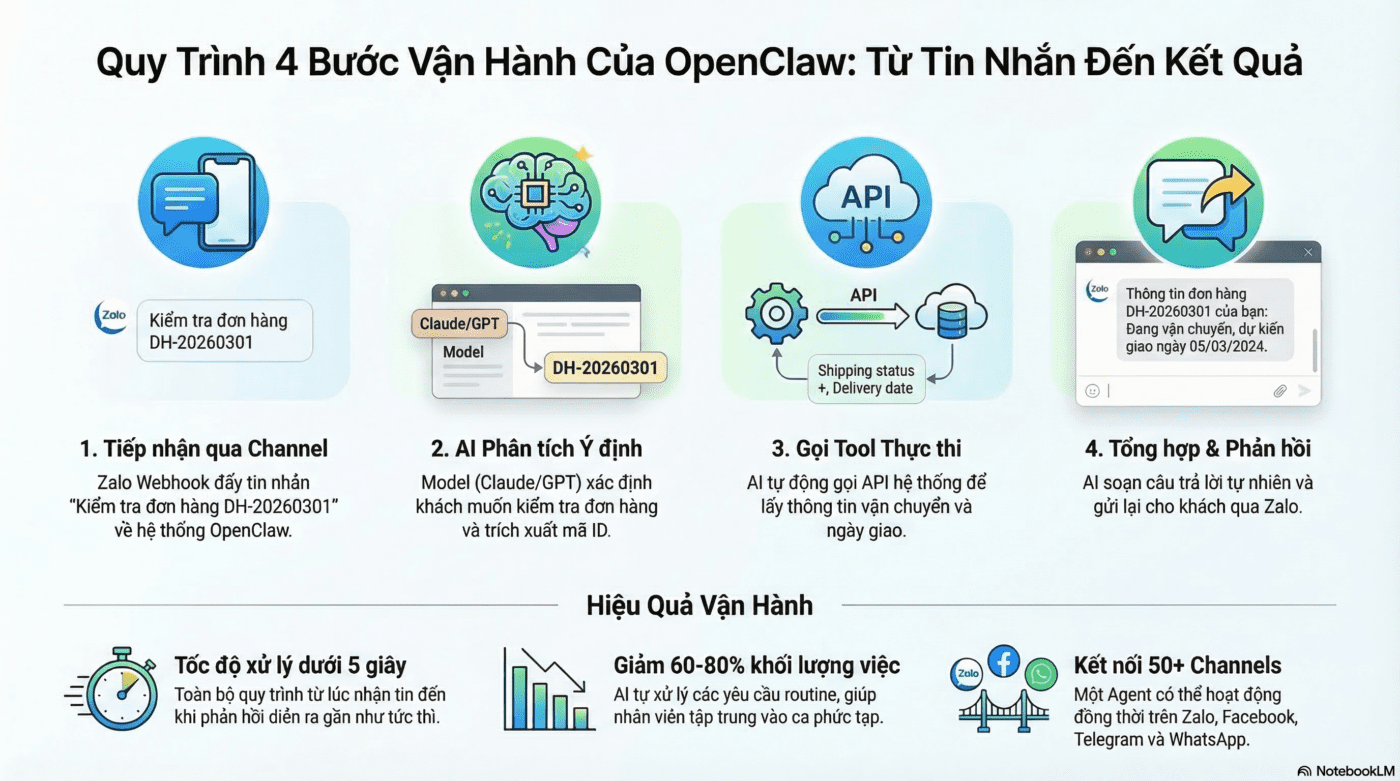
In previous articles, we explored the concept of AI Agents and an overview of OpenClaw. In this article, we will dive deeper into how OpenClaw actually works through a specific scenario: a customer asking about their order status via Zalo.
Scenario: Customer Inquires About Order via Zalo
Context:
An online fashion store uses Zalo Official Account (OA) for customer support. The order management system runs on a web platform with internal APIs.
Customer message:
“Hi, can you check where my order DH-20260301 is now?”
Let’s walk through how OpenClaw processes this request step by step.
Step 1: Receiving the Message via Channel
OpenClaw connects to Zalo OA through a Channel. When a customer sends a message, Zalo’s webhook pushes the content to OpenClaw. The framework receives the message and moves it to the analysis stage.
Note:
OpenClaw supports 50+ channels (Telegram, WhatsApp, Facebook Messenger, Slack, etc.). A single AI Agent can serve customers across multiple platforms without rewriting logic.
Step 2: AI Model Analysis and Planning
The message is sent to an AI Model (e.g., Claude or GPT), which analyzes and determines:
- Intent: The customer wants to check order status
- Extracted data: Order ID = DH-20260301
- Required action: Call the order tracking API
- Tool to use:
order_status_api
This step highlights the power of LLMs — the AI understands context and plans actions dynamically without relying on rigid scripts.
Step 3: Executing the Tool
OpenClaw calls a pre-configured tool — in this case, the internal API of the order management system:
GET /api/orders/DH-20260301/tracking
The API returns:
- Status: In transit
- Carrier: GHN
- Tracking number: GHN-987654
- Estimated delivery: March 15, 2026
Step 4: AI Generates the Response
The AI model receives the data and composes a natural response sent back to the customer via Zalo:
“Hello! Your order DH-20260301 is currently being shipped by GHN (tracking number: GHN-987654). The estimated delivery date is March 15, 2026. You can track it further on the GHN website.”
The Entire Process Takes Only Seconds
From the customer’s perspective, it’s just one question and one response. Behind the scenes, OpenClaw automatically executes a full pipeline:
Receive → Analyze → Call API → Synthesize → Respond
No human intervention required.
When Does AI Need Human Support?
OpenClaw is designed to handle most tasks autonomously but supports a human-in-the-loop mechanism for special cases:
- Requests beyond AI’s capabilities → escalated to human staff
- Critical actions (order cancellation, refunds) → require approval
- Sensitive information → transferred to responsible teams
This is the “AI-first, human-backup” model: AI handles routine tasks, humans handle exceptions.
The Power of Skills in OpenClaw
In this example, order tracking is a Skill. However, an AI Agent can be equipped with multiple skills:
- Product lookup – for pricing and specifications
- Appointment booking – for service scheduling
- Complaint classification – for issue handling
- Notification sending – reminders and promotions
The AI automatically selects the appropriate skill based on the user’s message. You configure once, and the system runs autonomously.
Conclusion
From this example, we can see that OpenClaw operates through a clear pipeline:
Channel → AI Model → Tools → AI Response
Its strength lies in the flexibility to integrate with any system via tools and skills.
In the next article, we will introduce the five most common real-world applications of OpenClaw in Vietnamese enterprises.


