

 Vietnamese
 Japanese
 English
Why Your Meeting Audio Should Never Leave Your Computer
Fujigo Software Solutions
Member of M&C Holdings (Japan)
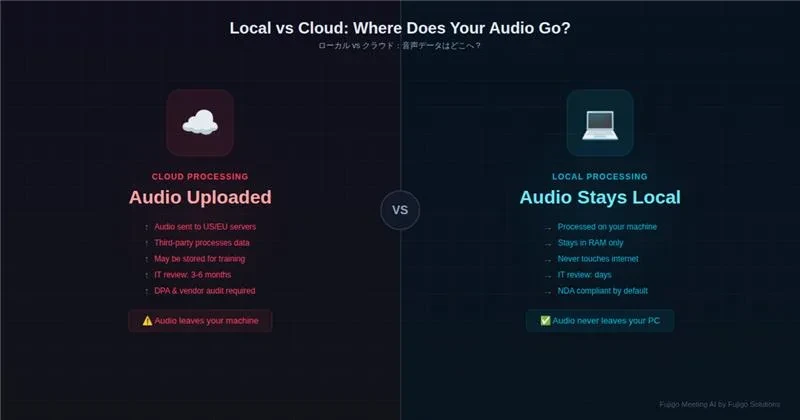
Where Does Your Audio Go?
When you start a meeting with most AI transcription tools:
- The mic captures audio
- Audio is compressed and uploaded to a cloud server (usually in the US or EU)
- A third-party STT service processes it
- Results are sent back to you
- The audio may be retained to “improve quality”
Product roadmaps, salary negotiations, customer business strategies — all sitting on someone else’s server, processed by a system you cannot audit.
The Problem With Japanese Clients
This isn’t theoretical. Japanese enterprises consistently rank data security as their number one concern when adopting cloud services. The concept of 情報漏洩 (information leakage) carries serious reputational consequences.
When a BrSE proposes a cloud-based AI meeting tool, the reaction from the client’s IT department:
- Security questionnaire — 50+ questions about data handling
- Vendor assessment — finances, compliance certifications
- Data processing agreement — legal DPA review
- Usually → rejection — the risk of audio data is too high
Procurement cycle: 6+ months. By the time it’s approved, the project is already halfway done.
Local Processing Changes Everything
The Cloud Model
Mic → Internet → Cloud STT Server → Internet → App
         ↓ Audio stored on remote server ↓
The Local Model (Fujigo Meeting AI)
Mic → Local STT Engine → App
         ↓ Audio in RAM, never written to disk, never touches the internet ↓
In practice this means:
- No third party accesses your voice data
- No data processing agreement needed
- No vendor security audit needed
- IT approval = a formality, not a 6-month project
- Automatically compliant with every NDA
“But Isn’t Cloud STT More Accurate?”
True in 2023. No longer true in 2026.
Whisper and SenseVoice run efficiently on 16GB+ RAM with accuracy on par with the cloud — especially for Japanese business speech when paired with a domain-specific glossary.
Fujigo Meeting AI injects a custom glossary as “hot words” into the STT engine. Project-specific terminology is often recognized more accurately than with a generic cloud service.
BYOK — The Middle-Ground Solution
LLM summaries need cloud compute → Fujigo Meeting AI uses BYOK (Bring Your Own Key):
- Use your own API key for cloud AI
- You control which provider processes the data
- Costs appear on your own API bill
- Fujigo Meeting AI never stores or proxies credentials
- Keys encrypted with AES-256-GCM
The sensitive part (raw audio) stays local. Only the text summary goes to the cloud, under your control.
Compliance Comparison
| Requirement | Cloud AI Tools | Fujigo Meeting AI (Local) |
|---|---|---|
| GDPR Article 28 | Required — vendor is a data processor | Not applicable — data never leaves the device |
| Japan’s APPI Law | Requires a vendor contract | Simple — data stays on the user side |
| Client NDA | May conflict with upload | Fully compatible |
| SOC 2 / ISO 27001 | Depends on the vendor | Not needed — no server |
| IT security review | 3-6 months | A few days → a few weeks |
The Real Cost of “Free” Cloud Tools
Cloud tools with a free tier rely on a business model that needs your data — model training, quality improvement, analytics. Your meeting audio has value to them.
Local processing is different: – Your hardware does the work – Your electricity pays for compute – No one else profits from your meeting content – No surprise bills — local is always $0
How to Make the Switch
- Check your hardware: 16GB+ RAM is enough for local STT
- Test accuracy: 2026 local models match the cloud for business speech
- Keep the cloud for AI features: BYOK for summaries + suggestions
- Announce the change: Japanese clients will appreciate the privacy upgrade
Download Fujigo Meeting AI for free → fujigo-meeting.app Privacy isn’t a feature. Privacy is architecture. — Fujigo Solutions
Related articles: